
Virtual Reality Endpoints Improve Measurement Of Patients' Real-World Benefit
A conversation with George Magrath, MD, CEO, Opus Genetics
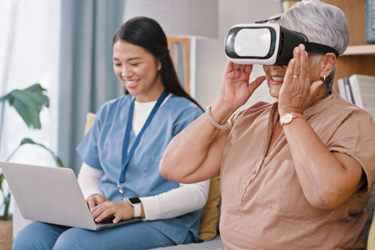
Virtual reality and digital endpoints measure what traditional clinic visits cannot: how people actually function in real-world settings and how quickly meaningful change can be detected. By embedding participants in controlled, life-like VR experiences and pairing them with continuous digital readouts, researchers with Opus Genetics are moving beyond traditional endpoints to capture and measure VR-based functional endpoints to determine reaction time, navigation accuracy, task success, and more — all while tightly standardizing conditions across research sites.
In this Q&A, Opus Genetics CEO George Magrath, MD, discusses how the company introduced virtual reality-enabled assessments and relied on digital endpoints to better measure participants’ vision changes in its Phase 3 OPGx-LCA5 gene therapy trial for LCA5, a type of early-onset retinal degeneration.
Clinical Leader: What prompted the exploration of new clinical endpoints measured by virtual reality and sensory technologies, and for what program? Additionally, what were the existing endpoints, and how did they fall short of your needs?
George Magrath, MD: Our decision to explore virtual reality (VR)-based and sensory-driven functional endpoints stemmed from a clear unmet need in our Leber congenital amaurosis and inherited retinal disease (IRD) programs, particularly OPGx-LCA5. Traditional assessments like best corrected visual acuity (BCVA) and full-field light sensitivity remain foundational in IRD research, but they often lack the resolution to detect early meaningful changes in how patients actually see and function. They also fall short of capturing the real-world visual challenges faced by individuals with ultra-rare retinal conditions.
These patients may navigate daily life with difficulties that standard tests don’t measure, such as moving through unfamiliar spaces, detecting motion, judging depth, adapting to shifting light, or recognizing objects against low-contrast backgrounds. Those functional limitations can remain invisible on chart-based endpoints even when they significantly impact independence and mobility. Bridging that gap required more immersive, task-based tools capable of measuring subtle improvements that matter most to patients.
VR technology allows us to do exactly that. It enables controlled, repeatable visual tasks such as obstacle navigation, object localization, orientation changes, and varying light or contrast conditions that mirror real-world demands while remaining standardized across clinical sites. Within the headset, we can precisely adjust luminance, contrast, motion cues, and spatial complexity, and capture continuous performance data including reaction time, trajectory, error rates, and task success.
These VR-enabled assessments create a lifelike yet measurable environment that quantifies functional vision with far greater precision. They offer clinicians a deeper view into early changes that traditional endpoints may miss, and they give patients a meaningful way to demonstrate improvements that reflect their lived experience, not just their performance in a clinic.
Tell us about the exploration and evaluation process for those endpoints. What factors ultimately led you to choose them?
We conducted a multistep evaluation that included landscape assessment, technical feasibility, user experience testing with patients, and early validation work with our clinical investigators. The technologies we ultimately advanced were those that could reliably reproduce real-world tasks, had quantifiable metrics, and were feasible to deploy across multiple sites without disrupting clinical workflow.
For example, technologies that required custom room setups, complex calibration, or subjective clinician scoring simply wouldn’t have worked. They would have disrupted site workflow and introduced too much variability across locations. That’s why we focused on tools that were portable, easy to standardize, and capable of generating objective automated measurements.
Equally important was ensuring the tasks were intuitive and accessible for patients with severe visual impairment. After analyzing reproducibility, clinician feedback, and the granularity of data output, we selected VR-driven navigation and sensory-based functional tasks that aligned most closely with the biological mechanism of our therapy and the daily challenges patients face.
Examples include navigating a virtual hallway with variable lighting, identifying moving objects against low-contrast backgrounds, locating targets that appear unpredictably in the periphery, and adjusting to sudden changes in brightness. These tasks mirror the real-world challenges patients encounter, while remaining standardized and quantifiable.

What interaction with or support from the FDA have you gotten?
We have had constructive dialogue with the FDA throughout this process. As part of our ongoing program-specific communications, we shared early concepts, validation data, and deployment plans with the agency. The FDA has encouraged continued development of fit-for-purpose assessments, particularly those that may better reflect functional improvements for patients with ultra-rare inherited retinal diseases. Their feedback has been helpful in refining our validation plan, ensuring the endpoints are anchored in both clinical relevance and methodological rigor.
We recently completed a productive Regenerative Medicine Advanced Therapy (RMAT) meeting with the FDA for OPGx-LCA5, which provided clear support for our adaptive Phase 3 design and the use of a run-in period where each participant serves as their own control. The agency acknowledged the urgent need in LCA5 and agreed that endpoints such as BCVA, full-field stimulus testing, microperimetry, and MLoMT are appropriate for this population. We also plan to apply for the FDA’s new Rare Disease Evidence Principles (RDEP) pathway, which is well aligned with the size and genetic clarity of LCA5. With six participants already showing meaningful improvements in our Phase 1/2 study and enrollment underway for the run-in period, this FDA feedback has helped streamline our path toward a potential first treatment for LCA5.
What guidances or advice have you integrated into your approach to ensure a positive reception by the FDA?
We aligned closely with recent FDA guidances related to digital health technologies, rare disease endpoint flexibility, and patient-focused drug development. Specifically, we incorporated FDA recommendations around verification and validation steps for novel digital endpoints, standardized data capture, and maintaining transparency in how the endpoints correlate with meaningful patient experience. We also integrated feedback from the agency on the importance of demonstrating cross-site reproducibility and clinical interpretability, which helped shape our data collection and training protocols.
What challenges did you overcome — or will still need to address — with this new implementation?
Introducing new digital and sensory-based endpoints into an early-stage IRD study naturally comes with challenges, including ensuring calibration consistency across sites, training personnel, and designing tasks accessible to patients with profound visual loss. Training includes ensuring that site personnel are fully comfortable operating the VR hardware, performing routine device calibration, and troubleshooting common technical issues. Staff must also be trained to guide patients safely through the tasks and maintain consistent testing conditions.
We also spent time building consensus among clinicians and patient advocacy stakeholders to ensure the endpoints truly reflect what matters to patients. Going forward, continued validation work and larger sample sizes will be essential to further refine sensitivity, reliability, and long-term utility.
What benefits do you hope this novel approach will bring?
Our goal is to more accurately capture how patients function in day-to-day life — and to detect meaningful changes earlier in the treatment journey. VR-based and sensory-driven assessments give us a level of precision and ecological validity that traditional endpoints often can’t provide. If successful, these tools may help accelerate development timelines, strengthen the interpretability of clinical outcomes, and ultimately expand the toolkit available for future IRD trials across the field.
Have you had any learnings thus far that can be used in future programs and trial designs?
Yes. One of the clearest learnings is that integrating novel endpoints early, ideally at the Phase 1/2 stage rather than layering them on later, helps ensure smooth operationalization and richer data sets. We also saw how valuable direct patient feedback is in optimizing task design. Finally, cross-functional alignment between clinical, regulatory, and digital health teams from the outset is essential to building endpoints that are both scientifically rigorous and operationally feasible. These lessons will inform our next programs, particularly as we continue to expand the Opus platform into additional IRDs.
About The Expert:
 George Magrath, MD, currently serves as CEO and board member of Opus Genetics, which was recently acquired by Ocuphire Pharma. Dr. Magrath is a board-certified ophthalmologist with extensive clinical, business, and financial experience. Most recently, Dr. Magrath was CEO of Lexitas Pharma Services, a leading CRO in ophthalmology. Lexitas experienced a substantial growth in headcount, expanded into multiple additional service offerings, including an image reading center and a significant shift into retinal diseases, and was acquired by a top-tier private equity group during Dr. Magrath’s tenure. Prior to Lexitas, Dr. Magrath served as the medical director at Hovione, where he helped develop proprietary assets in ophthalmology, dermatology, and respiratory. Dr. Magrath began his career as an equity analyst at Edison Investment Research, where he covered small and midsize pharma and biotechnology companies. Dr. Magrath holds an MAE from Johns Hopkins University, an MBA from The Citadel, and an MD from the Medical University of South Carolina.