
To Pick The Right Medical LLM, First Assess Your Readiness
By Niket Bajare, Research Analyst, Pharma R&D, Beroe

Medical large language models (LLMs) are being evaluated across clinical development for tasks involving protocols, investigator brochures, clinical study reports, safety narratives, scientific literature, and regulatory documents. Potential benefits include faster information retrieval, reduced drafting effort, and more consistent access to information across global trial teams. The World Health Organization identifies scientific research, drug development, and clerical and administrative work among potential applications of large multimodal models (LMMs).1
For sponsors, the decision is broader than selecting a high-performing model. A fluent answer from an LLM may still omit a critical eligibility criterion, misinterpret a safety narrative, or generate an unsupported statement. The complete solution must therefore be assessed across clinical performance, data privacy, cybersecurity, validation, workflow integration, human oversight, and contractual accountability.1,3,4
Organizations are evaluating LLMs across clinical trial activities including document drafting, evidence retrieval, protocol analysis, medical coding, patient-trial matching, and regulatory research. Adoption varies by model type: general-purpose and retrieval-augmented approaches are mature for text-based productivity and information-retrieval tasks, while multimodal and agentic models remain more emerging because they require greater data integration, workflow controls, validation, and human oversight. FDA and EMA guidance also emphasizes that AI used in drug development should have a clearly defined context of use, risk-based performance assessment, appropriate data governance, and life cycle management.13
Table 1: Medical LLMs in Clinical Trials
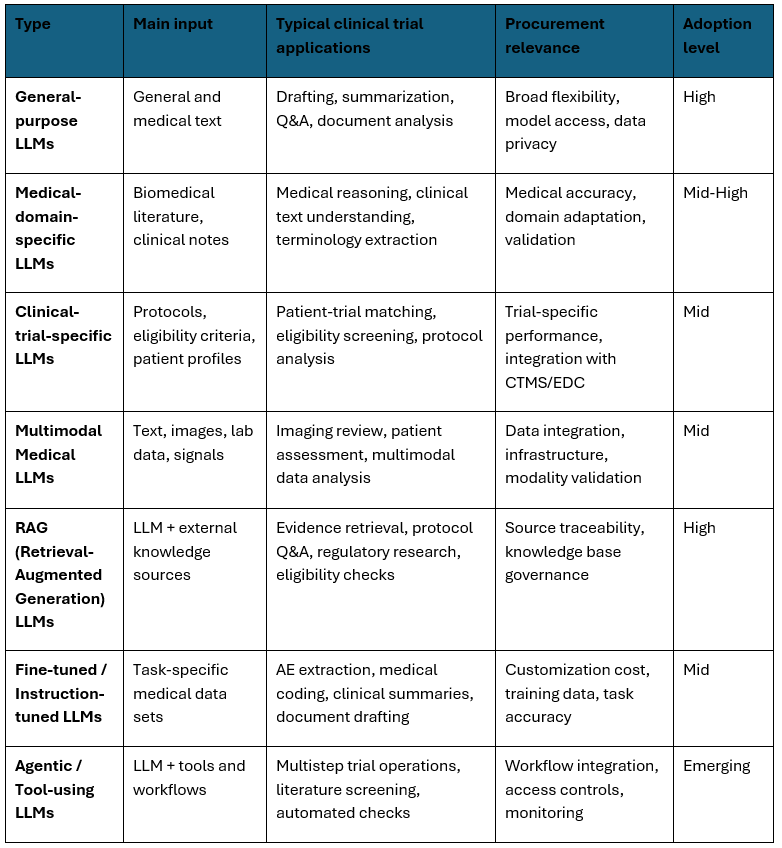
Sources: WHO, Ethics and governance of artificial intelligence for health: Guidance on large multi-modal models; WHO, Benefits and risks of using artificial intelligence for pharmaceutical development and delivery
Challenges In Current Clinical Trial Workflows
Modern clinical trials are becoming more geographically distributed, data-intensive, and operationally complex. As of July 2026, ClinicalTrials.gov listed 593,857 registered studies, including 453,135 interventional studies, illustrating the scale of the global clinical-development ecosystem. At the same time, operational complexity continues to affect recruitment, site activation, data management, and regulatory execution. Recent evidence indicates that 19% of clinical trials fail to recruit sufficient participants, while only about 50% complete enrollment within the originally planned timeline.14
- Increasing protocol complexity — Clinical trial endpoints are up 37%, countries have increased by 39%, and the number of patients has grown by 35% in 2026, increasing the workload for study teams. LLMs reduce this burden through protocol summarization, eligibility checks, and document analysis, but outputs require human validation.15
- Site and investigator burden — Protocol complexity is a top operational challenge for 38% of sites today, and protocol amendments continue to increase. There are 60% more amendments than in 2015. LLMs reduce repetitive site tasks, but procurement should prioritize workflow integration, usability, and human oversight.
- Regulatory reporting and evidence-management gaps — Thirty percent of studies potentially subject to mandatory reporting had no results submitted, highlighting gaps in clinical evidence management. LLMs support evidence extraction, document reconciliation, and regulatory reporting, but outputs require validation before submission.2
What Is Driving LLM Adoption?
Increasing documentation workloads, pressure to improve trial productivity, leaner clinical teams, and growing study complexity are all pushing sponsors toward LLM adoption. Decentralized and hybrid trials are also creating more distributed information and communication requirements, increasing demand. At the same time, ICH E6(R3) emphasizes quality by design, participant protection, reliable trial results, and proportionate risk-based approaches to trial conduct, all of which demand more resources.9
Recent industry examples show that AI adoption is broader than LLM use alone. Reuters reported in January 2026 that Novartis used AI-supported site selection in a 14,000-participant cardiovascular outcomes trial and described a reduction in the reported process time from four to six weeks to a two-hour meeting. This is an AI-enabled operational example, not evidence that an LLM alone produced the result. Reuters also reported Genmab’s plans to use Claude-powered agentic AI for clinical development activities, including post-trial analysis and preparation of graphs, tables, figures, and clinical study reports.
The Risks And Hidden Costs Of LLMs
Medical LLM economics are driven by more than model licensing. Major cost drivers include data preparation and governance, API/cloud infrastructure, CTMS/EDC integration, retrieval-augmented generation (RAG) development, validation, cybersecurity, human review, training, and continuous model monitoring. The National Institute of Standards and Technology (NIST) specifically recommends ongoing testing and risk controls for generative AI systems, while EMA highlights transparency, AI failure, and regulatory risks in medicines development.1,3
Table 2: Risks and Hidden Costs
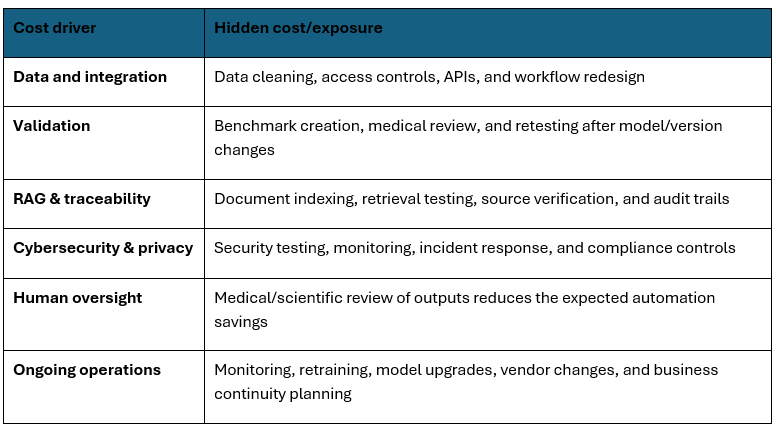
Sources: EMA, Reflection Paper on the Use of Artificial Intelligence in the Medicinal Product Lifecycle; NIST, Artificial Intelligence Risk Management Framework: Generative Artificial Intelligence Profile; WHO, Ethics and Governance of Artificial Intelligence for Health; IBM, Cost of a Data Breach Report 2026.

Decision Framework For Sponsors
Sponsors should evaluate a medical LLM through four decision gates: use-case risk, data/regulatory exposure, model and control readiness, and value realization. This reflects the risk-based approach recommended by the EMA, FDA, and WHO, where the required level of validation and oversight increases with patient impact, regulatory relevance, and model influence on decisions.1,2,8
Table 3: Decision Framework for Sponsors
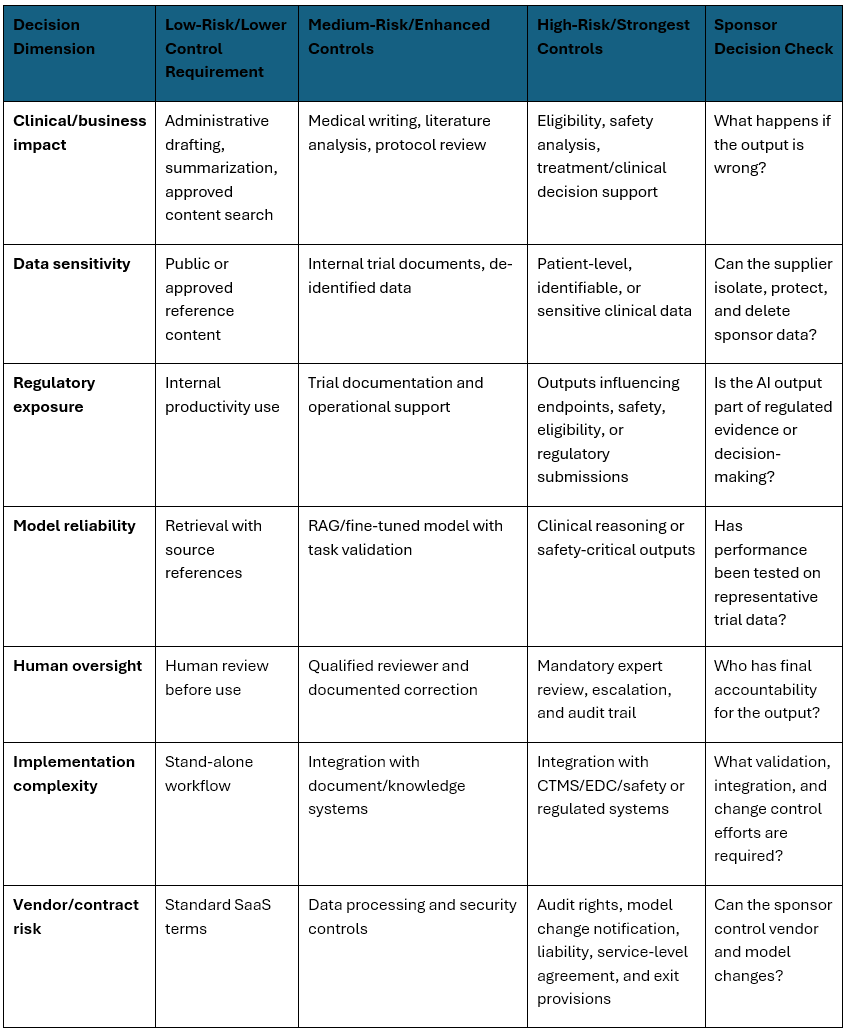
Sources: FDA, Considerations for the Use of Artificial Intelligence to Support Regulatory Decision-Making for Drug and Biological Products; EMA, Reflection Paper on the Use of Artificial Intelligence (AI) in the Medicinal Product Lifecycle.
Procurement And Supplier Evaluation Considerations
An RFP should evaluate the complete solution rather than only the underlying model. Suppliers should provide evidence on medical task performance, hallucination controls, source citation, audit trails, role-based access, encryption, data residency, integration standards, scalability, and model change governance.2,3,4,12
Table 4: Supplier Evaluation Framework
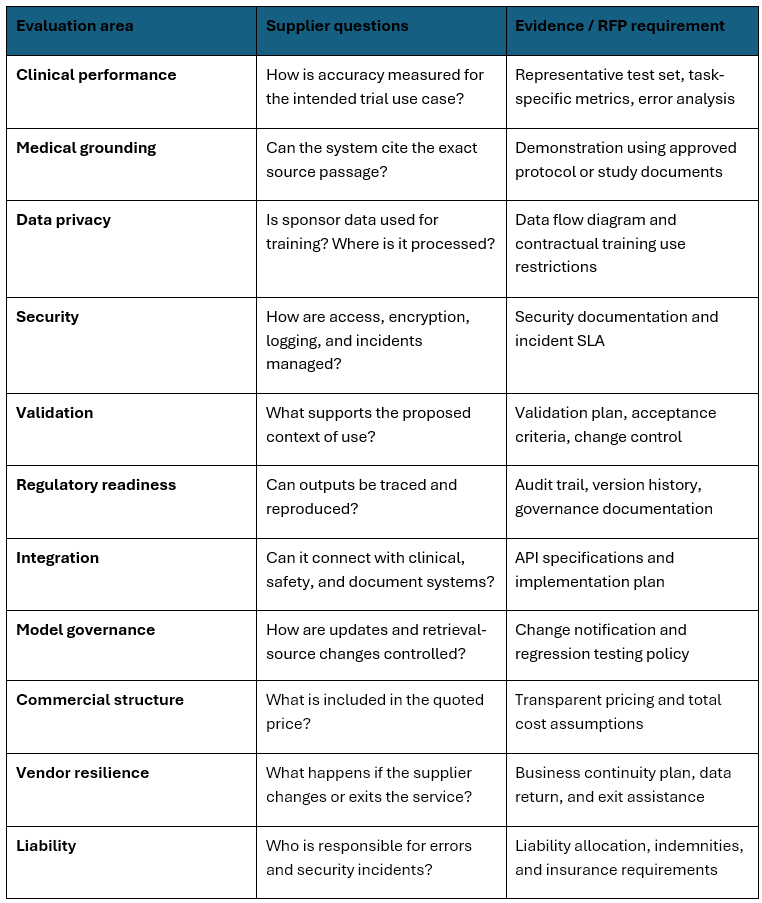
Sources: Ethics and governance of artificial intelligence for health: Guidance on large multi-modal models (2025); WHO, Ethics and governance of artificial intelligence for health (2021); U.S. FDA, Marketing Submission Recommendations for a Predetermined Change Control Plan for Artificial Intelligence-Enabled Device Software Functions (2025).
Conclusion And Procurement Recommendations
Sponsors should begin with clearly defined, measurable, lower-risk use cases and establish a baseline for productivity and quality before expanding deployment. Procurement teams should assess the model, data architecture, workflow integration, validation approach, and human review process together.3,2,9
The longer-term opportunity includes multimodal AI, real-world data analysis, agentic workflows, and AI-enabled CRO services. These developments may expand the supplier landscape, but they also increase the importance of governance, interoperability, and contractual control. The practical sourcing principle is to purchase a controlled, auditable workflow, not merely secure access to a language model.1,3
References:
- World Health Organization (WHO). Ethics and governance of artificial intelligence for health: Guidance on large multi-modal models. 2024. [Online]. Available: https://www.who.int/publications/i/item/9789240084759.
- U.S. Food and Drug Administration (FDA). Considerations for the Use of Artificial Intelligence to Support Regulatory Decision-Making for Drug and Biological Products. Draft guidance, January 2025. [Online]. Available: https://www.fda.gov/regulatory-information/search-fda-guidance-documents/considerations-use-artificial-intelligence-support-regulatory-decision-making-drug-and-biological.
- European Medicines Agency (EMA). Reflection paper on the use of Artificial Intelligence (AI) in the medicinal product lifecycle. Adopted 30 September 2024. [Online]. Available: https://www.ema.europa.eu/en/documents/scientific-guideline/reflection-paper-use-artificial-intelligence-ai-medicinal-product-lifecycle_en.pdf
- National Institute of Standards and Technology (NIST). Autio, C., et al. Artificial Intelligence Risk Management Framework: Generative Artificial Intelligence Profile. NIST AI 600-1, July 2024. [Online]. Available: https://www.nist.gov/publications/artificial-intelligence-risk-management-framework-generative-artificial-intelligence
- Rivera, S. C., et al. Guidelines for clinical trial protocols for interventions involving artificial intelligence: the SPIRIT-AI Extension. Nature Medicine, 2020. [Online]. Available: https://www.nature.com/articles/s41591-020-1037-7.
- Liu, X., et al. Reporting guidelines for clinical trial reports for interventions involving artificial intelligence: the CONSORT-AI extension. Nature Medicine, 2020. [Online]. Available: https://www.nature.com/articles/s41591-020-1034-x
- U.S. Food and Drug Administration (FDA). Artificial Intelligence-Enabled Device Software Functions: Lifecycle Management and Marketing Submission Recommendations. Draft guidance, January 2025. [Online]. Available: https://www.fda.gov/regulatory-information/search-fda-guidance-documents/artificial-intelligence-enabled-device-software-functions-lifecycle-management-and-marketing.
- International Council for Harmonisation (ICH). E6(R3) Good Clinical Practice. Current Principles and Annex 1 effective 23 July 2025; Annex 2 effective 15 January 2027. [Online]. Available: https://www.ema.europa.eu/en/ich-e6-good-clinical-practice-scientific-guideline.
- Lewis, P., et al. Retrieval-Augmented Generation for Knowledge-Intensive NLP Tasks. NeurIPS, 2020. [Online]. Available: https://arxiv.org/pdf/2005.11401.
- Singhal, K., et al. Large Language Models Encode Clinical Knowledge. Nature, 2023. [Online]. Available: https://www.nature.com/articles/s41586-023-06291-2.
- Nori, H., et al. Capabilities of GPT-4 on Medical Challenge Problems. arXiv, 2023. [Online]. Available: https://arxiv.org/abs/2303.13375
- Ibrahim, H., et al. Reporting guidelines for clinical trials of artificial intelligence interventions: the SPIRIT-AI and CONSORT-AI guidelines. Trials, 2021. [Online]. Available: https://pubmed.ncbi.nlm.nih.gov/33407780/
- Guiding Principles of Good AI Practice in Drug Development. [Online]. Available: https://pubmed.ncbi.nlm.nih.gov/33407780/
- NCBI Trends and Charts on Registered Studies [Online]. Available: https://clinicaltrials.gov/about-site/trends-charts
- NCBI Development of a protocol complexity tool: a framework designed to stimulate discussion and simplify study design [Online]. Available: https://pmc.ncbi.nlm.nih.gov/articles/PMC12395810/
About The Author:
 Niket Bajare is a research analyst in pharma R&D with experience in market intelligence, procurement research, and industry analysis across the pharmaceutical and life sciences sector. His expertise spans a range of pharma R&D categories, including clinical trials, cell and gene therapy, medical affairs, clinical packaging and labelling, laboratory equipment, and healthcare services. His core strengths include supplier landscape analysis, market benchmarking, industry trend assessment, and tracking emerging technologies, regulatory developments, M&A activity, and strategic collaborations. His work focuses on delivering data-driven insights and actionable intelligence that support procurement stakeholders in supplier evaluation, sourcing strategies, category management, and informed decision-making across the evolving pharmaceutical R&D ecosystem.