
The Cost And ROI Of Agentic AI In Clinical Trials: What Sponsors And CROs Need To Know
By T.G. Prasanna, category specialist – IT & Telecom, Beroe, Inc.

The clinical trials industry is moving from AI experimentation to operating model redesign. Sponsors and CROs have already seen meaningful results from AI-enabled pilots, but the economic challenge begins when those pilots are scaled across regulated multisystem clinical workflows. The market signal is strong: One 2026 market analysis estimates the AI in pharmaceutical market at $6.16 billion in 2026, with a 41.52% CAGR through 2031.1 It is projected that agentic AI could improve clinical development productivity by 35% to 45% within five years.2 Both figures are directional signals, not guaranteed outcomes.
This article provides a procurement intelligence framework for clinical operations, quality, finance, and IT leaders at sponsor companies and CROs. It explains how to size investment requirements, distinguish proven outcomes from analyst projections, model ROI realistically, understand the shift in SaaS pricing structures, and make a defensible build vs. buy decision before committing budgets.
The central conclusion is simple: Agentic AI in clinical trials should not be evaluated as another software purchase. It should be evaluated as a regulated operating cost transformation, with platform, orchestration, compliance, validation, and oversight costs modeled together.
From Copilots To Autonomous Operators: What Is Agentic AI?
The distinction between generative AI and agentic AI is operationally significant. It is also the hinge on which the ROI argument turns.
Generative AI functions as a sophisticated assistant: It analyzes information, drafts content, summarizes evidence, and surfaces recommendations for a human user. Agentic AI occupies a different position. It can plan, sequence, and execute multistep workflows within defined boundaries, often by coordinating with other systems or specialized agents. In a clinical trial setting, that could mean not merely drafting a site-monitoring summary but checking incoming data, identifying anomalies, creating a query draft, routing it for human review, and updating the audit trail when approved.
This distinction matters for three reasons in regulated clinical environments. First, agentic systems may coordinate across EDC, CTMS, eTMF, ePRO, regulatory information management, and safety systems in ways that simple copilots cannot. Second, the value opportunity is greatest in repeatable, data-intensive workflows where manual delays create white space. Third, the compliance footprint is larger: If an agent creates, modifies, maintains, archives, retrieves, or transmits electronic records that fall under FDA-regulated clinical investigations, sponsors and CROs must consider 21 CFR Part 11 expectations for trustworthy, reliable, and auditable electronic records and signatures.
A practical procurement definition is therefore useful: Agentic AI is a bounded, auditable, software-driven workflow operator that can execute defined clinical tasks with human oversight, system controls, validation evidence, and change management.
Where Agentic AI Is Creating Value In Clinical Trials
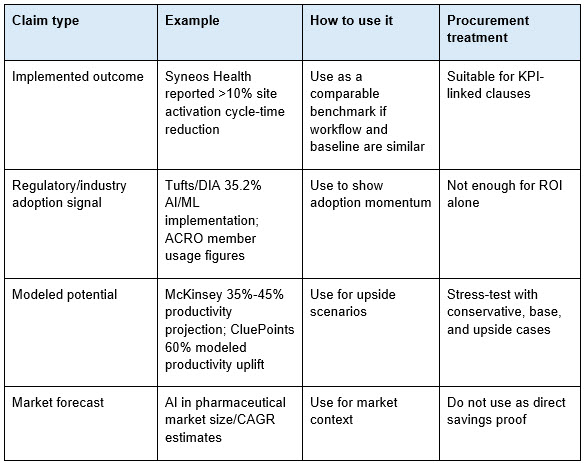
The evidence base is growing, but it is uneven. Some figures are based on implemented AI or analytics programs, while others are forward-looking projections. Procurement teams should separate these categories before building a business case.
A Tufts CSDD/DIA assessment reported that 35.2% of sponsor companies and CROs had partially or fully implemented AI/ML activities related to clinical trial execution.4 ACRO reported broad AI usage among CRO members, including AI for data management, site selection and activation, protocol optimization, risk planning, and site monitoring.5 These findings support the conclusion that adoption is no longer hypothetical, but they do not by themselves prove enterprisewide agentic AI ROI.
The use cases with the strongest near-term procurement relevance cluster around five workflow domains:
- Protocol design and simulation: AI-enabled simulation can stress-test eligibility criteria, expected enrollment curves, cohort feasibility, and amendment risk before first-site activation. Treat time-saving estimates in this area as scenario assumptions unless supported by sponsor-specific baselines.
- Site selection and patient recruitment: This is one of the more evidence-supported areas. Syneos Health has reported reducing site activation cycle time by more than 10% using AI-driven site-identification processes.6 Reuters has also reported examples of large pharma using AI to accelerate trial setup and enrollment, including GSK citing approximately £8 million in savings in a late-stage asthma trial.7
- Risk-based monitoring and data management: Agentic systems can continuously monitor EDC streams, flag anomalies, suggest queries, and prioritize human review. CluePoints-linked analysis reported modeling that multiple agents working with human reviewers and biostatisticians could improve data programming and management productivity by up to 60%.8 This should be treated as modeled potential not a universal realized benchmark.
- eTMF and inspection readiness: Agents can track document completeness, metadata quality, due dates, and missing artifacts in real time. The ROI is often soft but material: fewer late-stage reconciliation efforts, stronger inspection readiness, and reduced probability of documentation gaps.
- Regulatory document generation: Sponsors and CROs are using AI to manage high-volume documentation, clinical summaries, and submission-related formatting. The value case is strongest where outputs remain reviewable, traceable, and subject to medical, regulatory, and quality approval rather than fully autonomous finalization.
Claim-Quality Lens For Business Cases
Sizing The Investment: The Three-Layer Cost Architecture
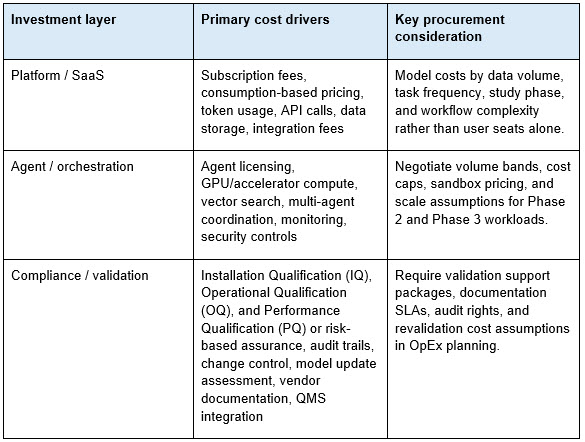
Investment in agentic AI for clinical trials is best understood through a three-layer cost architecture. Vendor proposals often foreground license fees, but the total cost of ownership sits across platform access, agent orchestration, and regulated validation.
Platform Layer: Saas Integration Costs
Traditional eClinical platforms — EDC, CTMS, eTMF, ePRO, safety, and regulatory systems — have often been priced around users, sites, studies, or modules. Agentic AI changes this logic. As AI agents perform tasks across systems, pricing can shift toward consumption, workflow runs, API calls, token usage, automation credits, or outcome-linked fees. Sponsors should model costs based on data volume, workflow frequency, study complexity, and phase progression, not simply user count.
Agent Layer: Orchestration And Compute Costs
Dedicated agentic orchestration environments allow specialized agents to collaborate across trial functions. These environments may involve cloud hosting, GPU or accelerator usage, vector databases, model monitoring, retrieval pipelines, integration middleware, and security controls. Costs scale with the number of workflows, data refresh frequency, complexity of reasoning tasks, and the level of human review required.
Compliance And Validation Layer: The Hidden Recurring Cost
For any agentic system operating in a GxP or clinical investigation environment, compliance cost is material. FDA and EMA good AI practice principles emphasize human-centric design, risk-based approaches, transparency, reliability, security, and life cycle monitoring.9 FDA guidance on electronic systems and records in clinical investigations reinforces expectations for records and signatures that are trustworthy, reliable, and generally equivalent to paper records and handwritten signatures.3 FDA computer software assurance guidance also reinforces risk-based assurance for software used in regulated quality contexts.10 For agentic AI, this means validation happens at deployment as well as with model updates, workflow reconfiguration, integration changes, and prompt or policy changes, which may require documented impact assessment and, sometimes, revalidation.
ROI And Payback: A Framework, Not A Formula
McKinsey projects that agentic AI could improve clinical development productivity by 35% to 45% within five years.2 That is a useful strategic benchmark, but it should not be inserted into a budget model as a guaranteed saving. Procurement and finance teams should deconstruct ROI into measurable workflow-level benefits.
- Hard ROI: Cycle time reduction, labor hour reduction, query resolution improvement, fewer manual reconciliations, reduced site activation time, fewer duplicate reviews, and measurable reduction in documentation turnaround time.
- Soft ROI: Improved eTMF completeness, better audit readiness, higher data quality, fewer late-stage cleanup cycles, reduced screen failures, and improved site or patient targeting.
- Strategic ROI: Earlier database lock, faster submission readiness, better CRO proposal differentiation, more resilient clinical operations, and stronger decision quality across development programs.

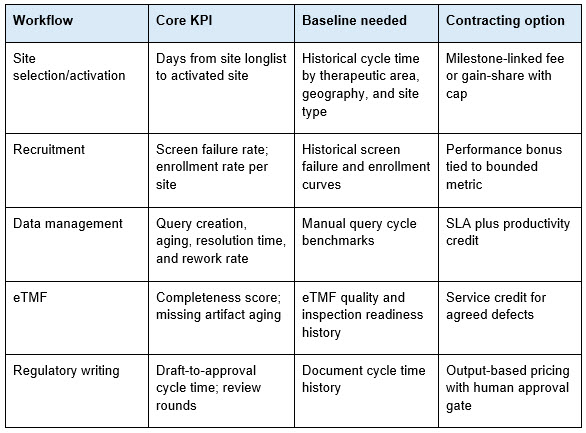
Payback is most defensible when the first deployments are scoped to bounded, repeatable jobs: medical coding assistance, site feasibility scoring, query triage, eTMF completeness checks, or document draft assembly. Enterprisewide autonomy is a longer-horizon strategy and should be justified only after workflow-level evidence has been established.
Recommended KPI Set
How Agentic AI Reshapes Traditional SaaS Cost Structures
Agentic AI is changing how eClinical vendors price work and how sponsors experience cost risk.
- From per-seat to consumption-based pricing: As agents execute tasks that previously required human users, user-seat pricing becomes less aligned with value delivery. Contracts should define included workflow volumes, token or API allowances, overage rates, and measurement methods.
- From fixed to variable cost profiles: Agentic workflows can become more expensive as trial data volumes grow, global sites activate, and monitoring frequency increases. Multiyear contracts should include volume bands, annual escalation limits, and study phase scenarios.
- From deployment validation to life cycle assurance: Traditional software validation often centered around implementation. Agentic AI requires ongoing governance across model updates, workflow changes, prompt library changes, data source changes, and integration changes.
- From generic AI terms to auditable operating commitments: Sponsors should avoid vague AI addenda. Contracts should specify audit trails, human approval gates, data retention, model monitoring, incident handling, explainability, validation artifacts, and subprocessor controls.
Vendor Evaluation Checklist For Sponsors And CROs
Before signing an agentic AI agreement, procurement teams should require clear answers to the following questions:
- Which exact clinical workflows will the agent execute, recommend, or draft for review?
- What actions are autonomous, and which require human approval before system-of-record updates?
- Which systems will the agent read from and write to: EDC, CTMS, eTMF, safety, regulatory, or data lake environments?
- What audit trail is generated for every input, recommendation, action, override, and human approval?
- What validation package is supplied: requirements traceability, test scripts, risk assessment, release notes, and model change documentation?
- How are model, prompt, workflow, and integration changes governed and communicated?
- Who owns sponsor data, derived data, embeddings, fine-tuned models, prompts, outputs, and workflow configurations?
- What pricing unit is used: user, study, site, workflow run, token, document, query, API call, or outcome?
- What happens when usage exceeds contracted volume bands?
- What evidence supports claimed productivity improvements, and is it from implemented deployments, pilots, models, or analyst estimates?
- How does the vendor support inspection readiness, audit rights, regulator questions, and post-deployment incident response?
- Can the solution scale from a Phase 1 pilot to a Phase 3 global trial without re-architecture or material revalidation?
Build Vs. Buy: A Decision Framework For Sponsors And CROs
The build vs. buy decision is more consequential in clinical trials than in many other technology categories because technical architecture, data rights, quality systems, validation evidence, and regulatory accountability cannot be separated.
For most sponsors and midsize CROs, purpose-built vendor solutions are the more pragmatic entry point, particularly for bounded workflows where the vendor already has integrations, validation templates, and domain controls.12 Internal builds may be justified when a sponsor has proprietary data assets, mature MLOps, strong quality-system integration, and a clear reason to own the workflow layer. A third model, co-development, is increasingly attractive for large pharma organizations that want vendor acceleration while retaining negotiated rights over data, outputs, and domain-specific configurations.13
Four variables should govern the decision:
- IP and data control: Define ownership of trial data, derived data, embeddings, fine-tuned models, prompts, workflows, outputs, and reusable learnings before deployment begins.
- Compliance integration: Assess whether the vendor can support GxP-aligned documentation, good AI practice principles, Part 11 expectations where applicable, audit trails, QMS integration, and change control.
- Scalability: Test whether the system can move from a pilot to a global trial without major re-architecture, uncontrolled cost escalation, or revalidation surprises.
- Total cost horizon: Compare build and buy across three to five years, including specialist talent, cybersecurity, validation, vendor management, model monitoring, change control, integration maintenance, and incident response.
Conclusion
The question facing sponsors and CROs in 2026 is not whether to invest in AI but how and where to invest with the rigor that regulated clinical operations demand.
That means sizing investment across platform, agent, and compliance layers rather than relying on license quotes alone. It means using hard ROI where metrics are measurable, soft ROI where operational quality improves, and strategic ROI where faster, cleaner development decisions improve enterprise competitiveness. It also means renegotiating SaaS contracts that were designed for a pre-agentic world and insisting on validation, auditability, data rights clarity, and cost controls before deployment.
Agentic AI may transform clinical trial operations. Organizations that approach it with procurement discipline, quality system discipline, and realistic ROI modeling will be best positioned to capture that transformation without being surprised by its true cost.
References:
- Mordor Intelligence. Artificial Intelligence (AI) in Pharmaceutical Market Analysis. February 2026. https://www.mordorintelligence.com/industry-reports/artificial-intelligence-in-pharmaceutical-market
- McKinsey & Company. Agentic AI advantage for pharma. October 2025; and Reimagining life science enterprises with agentic AI. September 2025. https://www.mckinsey.com/featured-insights/week-in-charts/agentic-ai-advantage-for-pharma
- U.S. Food and Drug Administration. Electronic Systems, Electronic Records, and Electronic Signatures in Clinical Investigations: Questions and Answers. Guidance for Industry. October 2024. https://www.fda.gov/regulatory-information/search-fda-guidance-documents/electronic-systems-electronic-records-and-electronic-signatures-clinical-investigations-questions
- Applied Clinical Trials / Tufts CSDD and DIA. New Insights on the Impact of AI-Enabled Solutions. June 2025. https://www.appliedclinicaltrialsonline.com/view/new-insights-on-the-impact-of-ai-enabled-solutions
- ACRO. State of the Industry Report / AI usage highlights. 2026. https://www.acrohealth.org/acro-state-of-industry-report/
- Microsoft Customer Story. Syneos Health reduces time for clinical trial site activation with Microsoft Azure OpenAI Service. March 2025. https://www.microsoft.com/en/customers/story/22558-syneos-health-azure-open-ai-service
- Reuters. Drugmakers turn to AI to speed trials, regulatory submissions. January 2026. https://www.reuters.com/legal/litigation/drugmakers-turn-ai-speed-trials-regulatory-submissions-2026-01-26/
- Clinical Research News Online. Is Agentic AI the Next Leap Forward for Clinical Trial Data Management? March 2026. https://www.clinicalresearchnewsonline.com/news/2026/03/20/is-agentic-ai-the--next-leap-forward--for-clinical-trial-data-management
- U.S. FDA and European Medicines Agency. Guiding Principles of Good AI Practice in Drug Development. January 2026. https://www.fda.gov/about-fda/artificial-intelligence-drug-development/guiding-principles-good-ai-practice-drug-development
- U.S. Food and Drug Administration. Computer Software Assurance for Production and Quality Management System Software. September 2025; revised February 2026. https://www.fda.gov/regulatory-information/search-fda-guidance-documents/computer-software-assurance-production-and-quality-management-system-software
- 21 CFR Part 11 - Electronic Records; Electronic Signatures. eCFR. https://www.ecfr.gov/current/title-21/chapter-I/subchapter-A/part-11
- Pharmaphorum. Agentic AI is Ready. Most Pharma Organizations Are Not. March 2026. https://pharmaphorum.com/event/agentic-ai-ready-most-pharma-organizations-are-not
- The New Stack. Agentic AI build vs buy in regulated industries. May 2026. https://thenewstack.io/agentic-ai-build-buy/
About The Author:
 T.G. Prasanna is a category specialist in IT hardware at Beroe Inc., a globally recognized procurement intelligence firm serving Fortune 500 clients across industries including life sciences and pharmaceuticals. With nearly a decade at Beroe and more than 15 years of post-MBA experience spanning market research and strategy consulting, he specializes in data center infrastructure, cloud infrastructure, and storage technologies, delivering market intelligence, cost structure analysis, and vendor capability assessments that help procurement leaders make informed, defensible technology decisions. Prior to Beroe, he served as a research analyst at Accenture, supporting growth and strategy initiatives across the electronics and high technology, and aerospace and defense sectors.