
Clinical Trial Standards — What They Are And Why They're Indispensable
By Tushar Sinkar

Clinical trials depend on a wide range of standards that govern how information is designed, collected, exchanged, analyzed, and submitted. Despite this structure, fragmentation still occurs. A protocol amendment, a new assessment, or a shift in operational planning can ripple across dozens of systems and stakeholders. When this happens, organizations often struggle to answer: What does this change actually affect?
Understanding that question requires clarity on four foundational issues:
- First, why does clinical development rely on so many different standards, and what distinct roles do they play?
- Second, how can a single change, such as a new visit or assessment, expose weaknesses in the underlying architecture that connects those standards?
- Third, why does connected context matter, and what happens when meaning, provenance, and relationships fail to travel with the data?
- Finally, why do AI systems struggle when that context is missing, even when they can read documents, summarize amendments, or extract structured elements?
These questions frame the central challenge: Standards can give clinical information structure, but the context surrounding that information must remain connected as it moves across the trial life cycle.
Why Does Clinical Development Use So Many Standards?
Clinical development spans scientific design, operational execution, data acquisition, safety oversight, statistical analysis, and regulatory communication. No single standard can support all these functions. Instead, each standard solves a specific problem and contributes a distinct capability across the trial life cycle.
Table 1. How the Clinical Trial Standards Ecosystem Fits Together
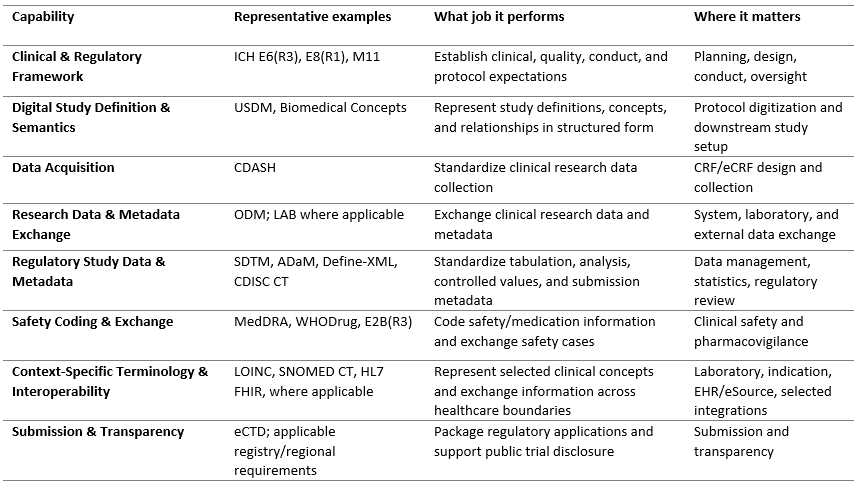
These standards address different, often complementary needs. Viewed together, they support different parts of the clinical development life cycle.
Governance Runs Through The Workflow
Clinical trials rely on trust in data, systems, processes, and decisions. Governance mechanisms help maintain that trust across the life cycle.
ICH E6(R3) and E8(R1) provide clinical and quality principles, including proportionate approaches and the design of quality into clinical studies. GAMP 5 provides industry good practice guidance for regulated computerized systems, while ALCOA+ expresses data integrity principles. Information security may draw on standards and frameworks such as ISO/IEC 27001 and NIST CSF, as well as applicable privacy and data protection requirements. For AI, ISO/IEC 42001 and the NIST AI Risk Management Framework provide additional management and risk governance approaches.
Together, these principles, standards, requirements, and frameworks help establish the controls needed to ensure information is created, exchanged, interpreted, and acted upon in a reliable and accountable manner.

How One Change Exposes The Architecture
A small protocol amendment — such as adding a Week 12 visit with an HbA1c assessment — may appear simple. In practice, the schedule of activities and study definition must reflect the new visit. The CRF and EDC configuration may need new assessment fields, visit windows, and edit checks. Laboratory specifications may need updated sampling, timing, units, handling, and data transfer requirements. The additional data may also need to be represented in submission datasets and, where relevant, reflected in downstream analysis. Sites and vendors may require updated instructions, testing, training, and change control.
Each component may be correct individually. The challenge is ensuring that the relationships among them remain visible as the change propagates. When those relationships are not explicit, teams must reconstruct context manually, often relying on tribal knowledge, scattered documents, or assumptions. This is where disconnected context becomes a real operational risk.
Why Connected Context Matters
A standard can be implemented correctly within its domain, and fragmentation can still appear when information crosses boundaries — from protocol to EDC, from EDC to data management, from data management to statistics, from statistics to regulatory, from clinical operations to vendors, and from safety to pharmacovigilance.
Moving data between systems does not guarantee that its context travels with it. Meaning can shift, provenance can be lost, ownership can become unclear, and relationships can break. When context is disconnected, teams face inconsistent interpretation, rework, delays, and increased risk.
Connected context helps preserve meaning and relationships as information moves across those boundaries. It allows teams to understand not just what changed, but why it matters and where it has downstream impact.
Why AI Fails Without Connected Context
AI can read a protocol and summarize an amendment. It may even have access to standardized data yet lack sufficient context to understand the impact of that change. But determining the enterprise impact of that amendment requires far more: authoritative study versions, relationships among visits and assessments, mappings between CRFs and data sets, operational state, ownership, previous decisions, permissions, and terminology alignment.
When this context is scattered across documents, applications, repositories, and workflows, AI must reconstruct relationships the enterprise itself has not made explicit. This can lead to incomplete impact assessments, inconsistent interpretations, loss of provenance, outdated assumptions, and recommendations based on incorrect sources.
Standardized data is necessary, but it does not by itself give an AI system the context required to understand enterprise impact. The model also needs access to the connected, governed context around that data.
From Connected Context To Enterprise Memory
Intelligent agents cannot start from zero with every interaction. They need enterprise memory — persistent, governed context that supports consistent reasoning across time.
Enterprise memory includes study definitions, semantic relationships, metadata, process state, business rules, ownership, previous decisions, provenance, and permissions. It is not another clinical standard but a way of retaining the governed context that intelligent systems need across standards, systems, and workflows.
Standards contribute structure. Enterprise systems contribute to state and ownership. Governance contributes trust. When these elements are connected, intelligent systems can reason rather than reconstruct.
Implications For Clinical Leaders
To support modern, intelligent clinical development, leaders must ask five questions when assessing clinical transformation:
- Meaning: Are the same clinical and business concepts understood consistently?
- Representation: Are we using the right standard for the right purpose?
- Exchange: Are we moving values while preserving metadata, relationships, and provenance?
- Trust: Can information and decisions be traced to governed sources and accountable owners?
- Memory: Can intelligent systems retrieve persistent context about study definitions, process state, rules, ownership, and previous decisions?
These questions shift the focus from implementing individual standards toward understanding the capabilities and connections the clinical trial needs.
Seeing The Standards As A Connected System
The complex clinical research standards ecosystem reflects the complexity of clinical development. What matters is understanding where each standard contributes and ensuring that the connections among them remain intact as information moves through the trial.
AI raises the stakes because intelligent systems depend on the relationships organizations make explicit. Clinical development, therefore, must not only standardize information but also connect the context.
Author’s note: The views expressed are personal professional perspectives and are independent of any current or past corporate affiliation.
About The Author:
 Tushar Sinkar is an AI and digital transformation leader with experience across clinical trials, enterprise technology, product delivery, and regulated transformation. He focuses on translating complex operational challenges into scalable digital capabilities across process orchestration, data readiness, governance, and responsible AI adoption.